
RU2690553 (C1)

Thermal unit for combined production of cement clinker, sulfur dioxide, heat and electric power

(22) 29.06.2018

(43) 04.06.2019

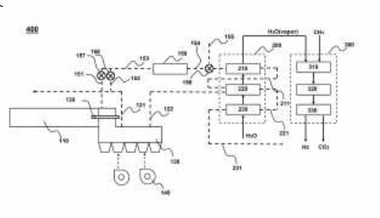
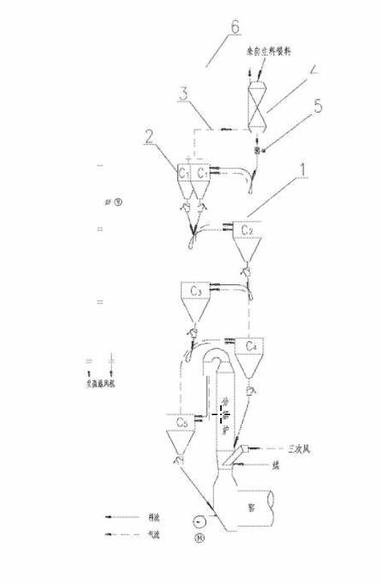
(57) Field: heating equipment. Substance: invention relates to a thermal unit for production of construction materials, in particular, cement clinker, and wasteless production of heat and electric energy. Thermal unit includes a steam power boiler operating on solid fuel of combustible industrial and domestic wastes, connected by a gas duct to a source of heat energy in the form of a furnace or separate furnace, at that, in order to increase the thermal unit operation efficiency, the heat energy source is made in the form of a smelting furnace of the straight-flow-vortex melting chamber type to obtain a fused cement clinker connected to the boiler by a water-cooled gas duct and equipped with a prechamber for intensive fuel combustion, which is connected by a leak channel with a cyclone precipitator calcium oxide, which in turn is connected to the fluidizing layer by the gas duct, and the latter by the outlet channel is connected to the direct-flow counter shaft pit heater of fine-dispersed wastes of phosphoric or boric acid production in the form of phosphorus or boron gas, connected by the gas duct to the fine-grinding milling mill with simultaneous drying, desulfurizer is connected via gas ducts via precipitation cyclone with shaft heater and further through it to mill, and desulfurizer has channel for input of high-sulfur oil coke. Effect: higher efficiency of operation of thermal unit, higher efficiency of heat and electric energy and maximum use of wastes of chemical production and production of fuel resources with almost complete waste-free operation with increase in range of products.

(71) Federalnoe gosudarstvennoe byudzhetnoe obrazovatelnoe uchrezhdenie vysshego obrazovaniya ufimskij go (RU)

Related articles:

Issue 04/2024 KR 20240053196 A

Hydrogen production system using waste heat of cement clinker production process

(22) 17.10.2022(43) 24.04.2024 (57) The present invention relates to a hydrogen production system. More specifically, it relates to a hydrogen production system using waste heat generated in the...

more
Issue 5/2021 WO2021085747 (A1)

Apparatus for decomposing and fixing greenhouse gases using waste-derived liquid fuel

(22) 23.12.2019(43) 06.05.2021(57) The present invention relates to an apparatus for decomposing and fixing greenhouse gases, the apparatus comprising a cement furnace, which, by gasification and...

more
Issue 7-8/2020 SK1902019 (U1)

Heating complex of the cement kiln/ lime kiln and high heat consuming devices

(22) 17.05.2019(43) 04.05.2020(57) The heating complex of the cement kiln or lime kiln or high heat consuming devices consists of a separate pyrolysis reactor (A) with a raw material input (C) of...

Heating complex of the cement kiln/ lime kiln and high heat consuming devices">more
Issue 7-8/2013

Innovation out of tradition

The cement factory proprietors of Südbayerische Portland-Zementwerke Gebr. Wiesböck & Co. GmbH have for many decades fully embraced their social, ecological and economical responsibilities. Continuous modernization and upgrading projects have safeguarded production at the factory location in Rohrdorf ( Fig. 1 ). The company’s latest projects are an SCR system and a waste heat recovery system [1, 2]. These were reason enough for ZKG INTERNATIONAL to present an overview of the whole factory. History The factory was established in 1930 as the family business of the Wiesböck brothers. Originally, the company quarried natural stone, but it later changed over to the production of cement. Despite initial scepticism, this business became more and more profitable. The commencement of an economic upswing made the situation more difficult, as a number of competing factories were set up in the surrounding area. At that time, a production limit of 6000 tpy was imposed on the factory. Despite this restriction, and with a generous interpretation of the imposed limit, business developed positively, so that the company participated actively in the years of the German‚ ‘economic miracle’. This was followed by a period of diversification, and the raising of the Iron Curtain prompted a great trend for economic engagement in Eastern Germany. In addition to the factory in Bavaria, the company now operates a grinding plant in Eiberg near Kufstein and a cement works in Gmunden/Austria. When Austria joined the EU the factory started supplying the Austrian region, i.e. the company served the entire surrounding market. The Rohrdorf Group presently has a turnover of around 250 million €, generated by five fields of activity: cement, ready mixed concrete, sand and gravel, concrete products and precast elements. On the cement sector the company operates two cement factories with clinker production and one grinding plant, two mixing plants in Gmunden and Rohrdorf for special products and 11 quarries. It also has a major shareholding in a recycling company manufacturing alternative fuels. More than 1000 ­people work for the group. Corporate philosophy “ Everything we do, we do a little sooner ” said ­Heinrich Rodlmayr, the company manager responsible for technology. “ Innovation has always been a central aspect of our corporate philosophy ” , he added. For example: the factory was one of the very first to install a X-ray fluorescence system for raw material analysis. Rohrdorf also pioneered the usage of alternative fuel and raw materials, such as no longer recyclable foundry sand ( Fig. 2 ) and waste products from Tetra Pak recycling. This strategy helps to ensure long-term production at the various Rohrdorf Group locations and to safeguard jobs. The production line The raw materials are transported from the quarries to the factories by railway or truck (Eiberg Plant). The company possesses concessions for the next 127 years, so there is no reason to doubt raw material availability. However, transportation of the materials from some of the more distant quarries is quite expensive, making it necessary to achieve savings in other areas, e.g. energy costs. The raw material is fed into a crusher and then transported to a blending bed. Raw material grinding is performed by a Quadropol vertical roller mill (260 t/h), after which the raw meal is supplied to a DOPOL preheater ( Fig. 3 ). The raw mill was put into operation in 2006, replacing the original ball mill that represented a bottleneck in the production process. This modernization measure increased the plant’s capacity from 3000 to 3500 tpd. In addition, the kiln inlet zone and the upper cyclone stage were modified and a new kiln exhaust gas fan was installed. At the same time, the electrostatic precipitator serving the plant was replaced with a combined bag filter for the kiln and raw mill. Alternative fuels and raw materials The employed alternative fuel ( Fig. 4 ) is a mixture of shredded tyres and roofing felt, which is supplied to the preheater. In addition, paper rejects are burnt in the kiln inlet zone. The alternative raw materials fed to the kiln inlet are foundry sands and a special lime, which is a waste product of the calcium cyanamide (lime-nitrogen) production process and also contains ammonia. The special lime has an effect like a non-controlled SNCR system, which brings the disadvantage that the plant previously had a very high volatile ammonia emission. This problem has been eliminated through the installation of a new SCR system. The average annual thermal substitution rate is 77 %. The company has a permit operation with a rate of 100 %....

more
Issue 04-05/2025 WO 2025/073567 A1

Plant for production of cement with thermal energy extraction

(22) 26.09.2024(43) 10.04.2025(57) The invention relates to a plant (100, 200, 300, 400) for producing cement clinker from raw meal, comprising at least one heat exchanger (110, 210, 310, 410) located...

more
×