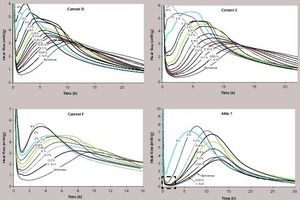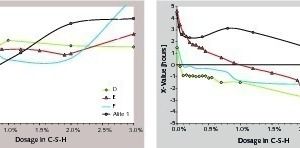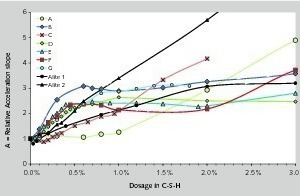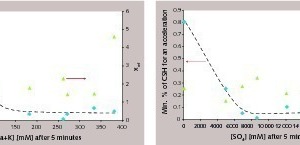
The acceleration of cement hydration by seeding: influence of the cement mineralogy
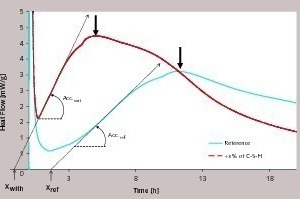
A new seeding technology, successfully applied in the concrete sector, is allowing concrete producers to accelerate their production or to replace cement by more cementitious materials.

1 Introduction

The development of the mechanical properties in ordinary Portland cement is closely linked to the hydration of tricalcium and dicalcium silicates. Accelerating the hydration of these phases, and therefore the setting and hardening of concrete, is highly desired in many applications, mainly for speeding up the production or to reduce the cement portion in the concrete mix design. The addition of seeds, namely the “seeding”, is a common practice to accelerate and control the crystallization and in this case to accelerate the cement hydration. Despite the fact that this idea is not...


Related articles:

Issue 4/2019 TECHNISCHE UNIVERSITÄT BERLIN

Accelerating cement hydration with C-S-H seeds

The acceleration of cement hydration through synthetic C-S-H shows great potential in increasing the early strength of cementitious systems. The selection of a suitable calcium-to-silicon ratio and...

more
Issue 02/2013

Formation of intermediate phases during hydration of C3S

The described model concepts can be employed as the basis for the development of binding agents possessing a significantly lower energy content and...

more
Issue 10/2020 UNIVERSITY OF SIEGEN

Investigation of hydration mechanisms of alpha and beta hemihydrate

Gypsum-based binders are generally based on the reaction between calcium sulfate hemihydrate (HH) and water to form calcium sulfate dihydrate (DH). Often gypsum can be used as a raw material to obtain...

more
Issue 5/2015 UNIVERSITY OF SIEGEN

Investigations of the hydration of calcium sulfate hemihydrate

The application of calcium sulphate based binders need different properties, which are influenced by the morphology of the dihydrate crystals, and which depend on applied additives, reaction temperature or the production conditions ...

more