Design of blending beds
 Dr.-Ing. Rüdiger Schramm
 FAM Förderanlagenbau Magdeburg
 FAM Förderanlagenbau Magdeburg
 FAM Förderanlagenbau Magdeburg
 Dr.-Ing. Rüdiger Schramm
 Dr.-Ing. Rüdiger Schramm
 Dr.-Ing. Rüdiger Schramm
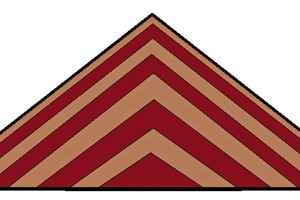
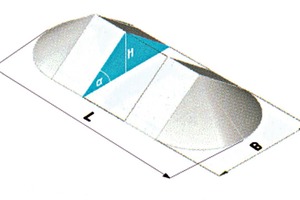
Blending beds are used for storage, mixing and homogenisation. For the most frequently used configuration, the longitudinal stack, using the “chevron” stacking variant, a design algorithm on the basis of a computing program is examined. In addition to determining the dimensions, the number of layers necessary for homogenisation is calculated on the basis of our own investigation data. The basic data for the stacking and reclaiming equipment to be used are determined.
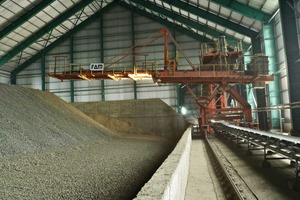
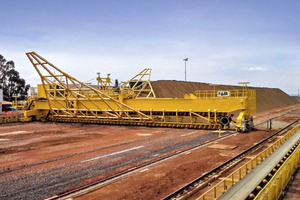
Blending beds are coming into increasing use in the cement, iron and steel and other industries. A blending bed, in general, has three functions:
Storage serves for stocking of sufficient feed material to assure maintenance of continuous operation during normal circumstances and, simultaneously, for absorbing fluctuations in production
Blending of components is intended to ensure that a certain number of feed materials of diverse chemical and/or physical properties are mixed together in amounts such that a desired composition is then present in the finished blending bed
Homogenisation is...