Investigation of the influence of crystal morphology on the strength development of various a-hemihydrates by use of an in-situ ultrasonic technique and complementary methods
![1 Temporal change in ultrasonic energy and velocity of a-hemihydrate (1) [W/aHH-ratio: 0.33, Temperature: 23 °C]](/uploads/images/2016/w300_h200_x400_y308_101549230_4e7a5c3132.jpg)
![2 Temporal change in ultrasonic frequency of a‑hemihydrate (1) [W/aHH-ratio: 0.33, Temperature: 23°C]](/uploads/images/2016/w300_h200_x400_y308_101549225_166152f723.jpg)
![3 Results of in-situ optical microscopy on hydration of a-hemihydrate (1) [W/aHH-ratio: 0.8, Temperature: 23°C]](/uploads/images/2016/w300_h200_x400_y319_101549215_5a9274436a.jpg)
![4 Temporal change in ultrasonic energy and velocity of a-hemihydrate (2) [W/aHH-ratio: 0.33, Temperature: 23°C]](/uploads/images/2016/w300_h200_x400_y308_101549191_70b99a6a63.jpg)
![5 Temporal change in ultrasonic frequency of a‑hemihydrate (2) [W/aHH-ratio: 0.33, Temperature: 23°C]](/uploads/images/2016/w300_h200_x400_y308_101549219_ea0ff15e73.jpg)
![6 Results of in-situ optical microscopy of hydration of a-hemihydrate (2) [W/aHH-ratio: 0.8, Temperature: 23 C]](/uploads/images/2016/w300_h200_x400_y285_101549205_ddb076041f.jpg)
![7 Temporal change in ultrasonic energy and velocity of a-hemihydrate (3) [W/aHH-ratio: 0.33, Temperature: 23°C]](/uploads/images/2016/w300_h200_x400_y308_101549187_f584d1ba60.jpg)
![8 Temporal change in ultrasonic frequency of a‑hemihydrate (3) [W/aHH-ratio: 0.33, Temperature: 23°C]](/uploads/images/2016/w300_h200_x400_y308_101549226_73ec7b44ee.jpg)
![9 Results of in-situ optical microscopy on hydration of a-hemihydtrate (3) [W/aHH-ratio: 0.8, Temperature: 23 C]](/uploads/images/2016/w300_h200_x400_y319_101549188_8fe2f32d0f.jpg)
![10 Temporal change in ultrasonic energy and velocity of a-hemihydrate (4) [W/aHH-ratio: 0.33, Temperature: 23°C]](/uploads/images/2016/w300_h200_x400_y308_101549197_7b9b18851b.jpg)
![11 Temporal change in ultrasonic frequency of a‑hemihydrate (4) [W/aHH-ratio: 0.33, Temperature: 23 C]](/uploads/images/2016/w300_h200_x400_y308_101549203_83335f6c48.jpg)
![12 Results of in-situ optical microscopy on hydration of a-Hemihydrate (4) [W/aHH-ratio: 0.8, Temperature: 23 C]](/uploads/images/2016/w300_h200_x400_y286_101549194_be8f3b6aca.jpg)
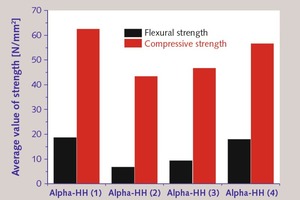
An efficient method to measure definite properties is the in-situ ultra-sonic wave measurement to characterize the hydration process of inorganic binding materials. A direct characterization of the chemical reactions taking place during the hydration process and the creation of the structure of the hydration product during the hydration is now possible because of the new interpretation technique of ultra-sonic results. In addition to the in-situ ultra-sonic wave measurements different other methods were used to verify the results of the ultra-sonic measurements.
The hydration of calcium sulphate hemihydrate is a dynamic process composed of various chemical reaction steps that take place in parallel. These reaction steps influence the utility properties of the gypsum stone created by the hydration of hemihydrate. The determination of technically relevant properties of modern, inorganic materials, e.g., workability, initial set, hydration progress and mechanical properties, involves the use of various time-consuming, conventional methods requiring substantial human-resource inputs. One efficient method of obtaining information on many such parameters...