The 11th International Symposium on Cement and Concrete (ISCC2025): charting the course for a low-carbon and digital future
1 Global policy and academic consensus: advancing the synergy of low-carbon development and digital transformation
The conference emphasized that the cement sector is a key focus of global low-carbon governance. Domestically, China’s stringent ultra-low emission targets for 2025 and 2028, together with the “Energy-Saving and Carbon-Reduction Action Plan”, establish a clear regulatory timeline. Internationally, mechanisms such as the EU’s Carbon Border Adjustment Mechanism (CBAM) are imposing binding constraints, compelling export-oriented producers to accelerate decarbonization efforts.
From an academic perspective, leading experts reached a consensus that the deep integration of low-carbon and digital-intelligent technologies is essential for achieving high-quality development. The symposium featured keynote presentations from a distinguished roster of international and Chinese academicians, who collectively addressed the industry’s most pressing challenges.
The Plenary reporters (Figures 1–6) are introduced below:

Fig. 1 Plenary Report by Professor Abdul Ghani Razaqpur (Numerical modelling of reinforcement corrosion due to chloride ingress and carbonation)
Professor Abdul Ghani Razaqpur (McMaster University, Canada) recommended the full integration of simulation and digital technologies to construct predictive models, such as for reinforcement corrosion, enabling scientific lifecycle management of structures.

Fig. 2 Plenary Report by Professor Ippei Maruyama (Carbonation progress in cementitious materials: role of water in the system)
Professor Ippei Maruyama (The University of Tokyo, Japan) presented forward-thinking research on transforming concrete into an active “carbon sink,” suggesting a future pathway toward carbon-neutral or even carbon-negative construction materials.

Fig. 3 Plenary Report by Professor Johann Peter Plank (Chemical admixtures—essential for successful transition to “green” binders)
Professor Johann Peter Plank (Technische Universität München, Germany) highlighted that the development of green admixtures specifically tailored to novel low-carbon binders represents a key pathway for decarbonizing cement-based materials.
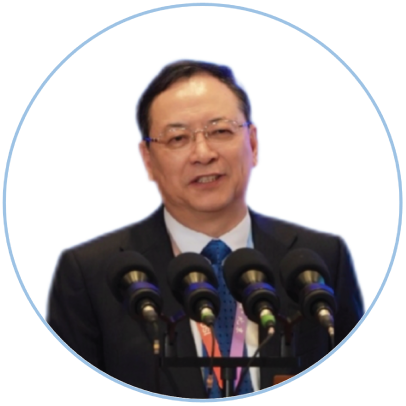
Fig. 4 Plenary Report by Professor Changwen Miao (Research status on cement-based metamaterials)
Professor Changwen Miao (Southeast University, China) emphasized the imperative to overcome the prevailing industry misconception that “low-carbon performance entails reduced efficiency.” He advocated for creating intelligent building material design paradigms through “multi-material combination, multi-scale structural ordering, and multifunctional integration” to enable diverse applications and support the development of future resilient urban systems.
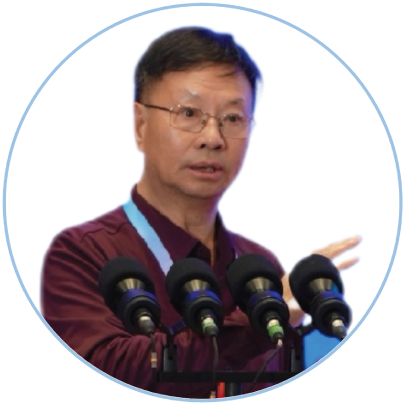
Fig. 5 Plenary Report by Professor Shilang Xu (Advances in frontier research of high-performance fiber-reinforced concrete)
Professor Shilang Xu (Zhejiang University, China) focused on synergistically optimizing the mechanical properties and durability of concrete materials, providing crucial technical support for engineering structural safety in extreme environments.
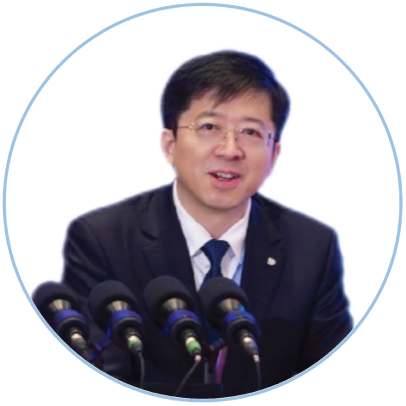
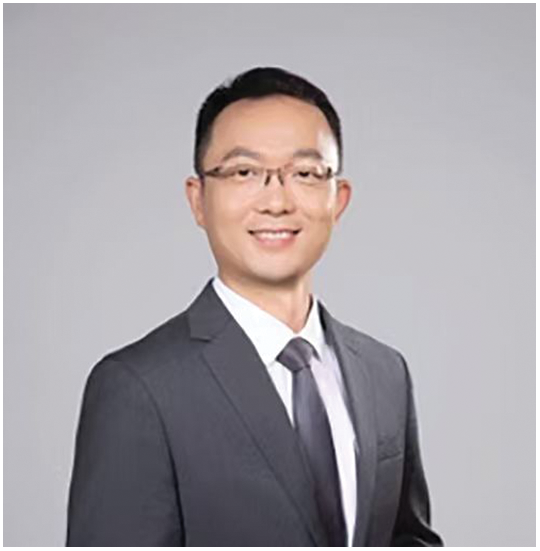
Fig. 6 Plenary Report by Professor Xiao Zhi (Digital design and intelligent manufacturing of low-carbon building materials)
Professor Xiao Zhi (CBMA, China) emphasized the importance of proactively adopting a data-driven research paradigm, transforming patented technologies into algorithmic logic through digital empowerment, and delivering software-based solutions to support cement industrial advancement, thereby fully realizing the multiplier effect of digitalization.
2 Technical advancements in digital intelligence, low-carbon innovation, durability enhancement, and resource circulation
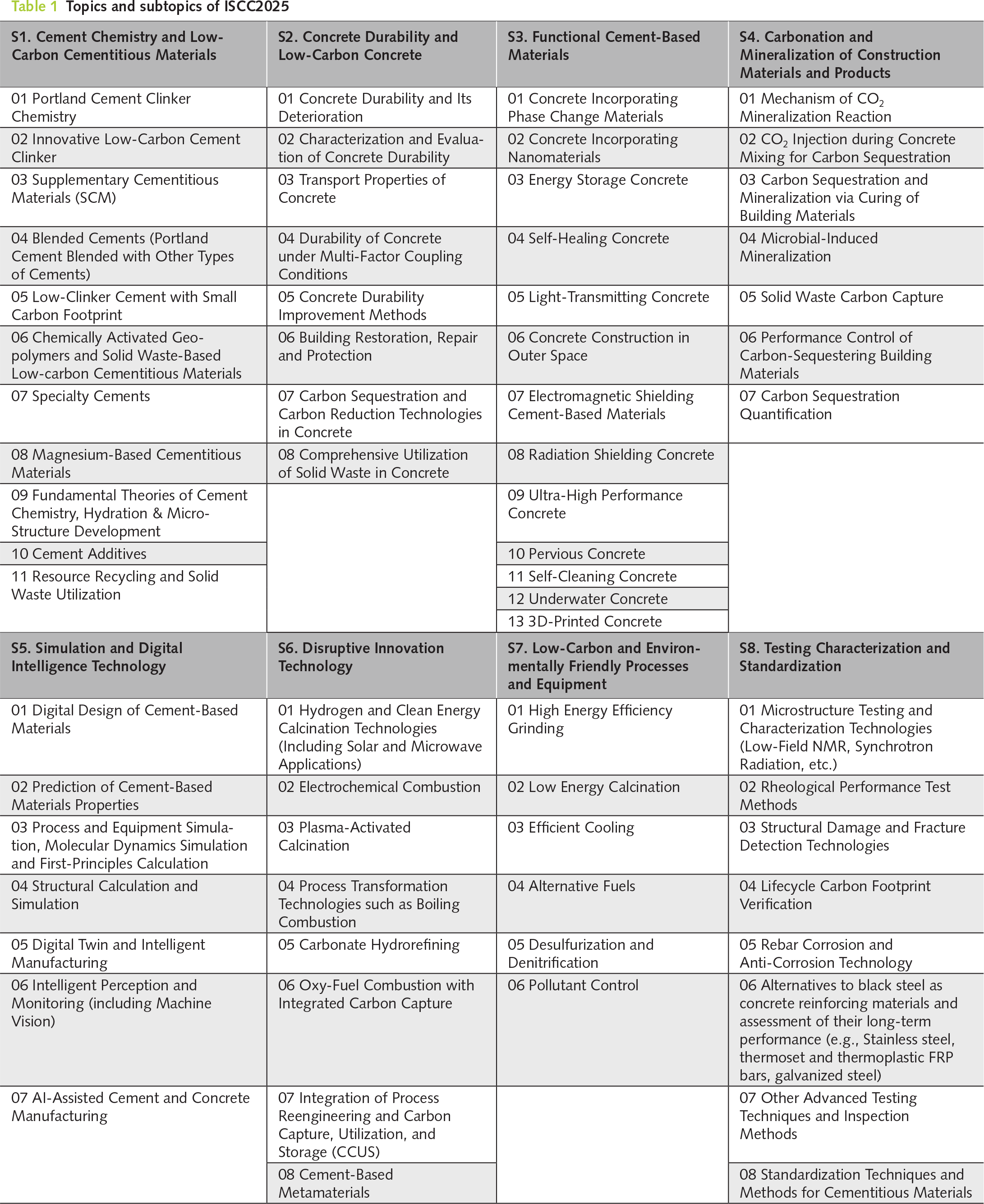
The conference showcased groundbreaking progress across four interconnected technological pillars, detailed across eight dedicated thematic sessions (specifically listed in Table 1) including Cement Chemistry and Low Carbon Cementitious Materials, Concrete Durability and Low Carbon Concrete, Functional Cement-based Materials, Carbonation and Mineralization of Construction Materials and Products, Simulation and Digital Intelligence Technology, Disruptive Innovation Technology, Low-carbon and Environmentally Friendly Processes and Equipment, Testing Characterization and Standardization.
2.1 Digital intelligence as a catalyst for systemic innovation
Digital tools are fundamentally reshaping R&D and production. The digital R&D platform for low-carbon cement-based materials, developed by the research team at the Cement Science and New Building Materials Academy of China Building Materials Academy (CBMA), has converted patented technologies into algorithmic frameworks, enabling efficient optimization and precise formulation. This drastically reduces R&D time and cost, representing a paradigm shift in material innovation. Integrated with the data nodes for inorganic non-metallic materials, the platform delivers a standardized, shareable digital infrastructure for collaborative research across the industry. Professor Horst-Michael Ludwig shared that intelligent control systems in clinker calcination can boost combustion efficiency by 5%–8% while cutting NOx emissions by over 10%. Furthermore, the intelligent central system at a batching station for the Shanghai-Chongqing-Chengdu high-speed rail achieved a 15% increase in production capacity utilization through real-time tracking and dynamic optimization.
2.2 Converging pathways for a low-carbon future
A multi-faceted technological portfolio for decarbonization was presented. Industry leaders like Thailand’s Siam Cement Group (SCG Group) showcased their progression in low-carbon cement, with 2nd and 3rd generation products aiming for 15–50% emission reductions, and Ultra-High Performance Concrete (UHPC) offering 20–60% lower emissions with enhanced performance in mechanical strength and durability. Chinese implementations highlighted integrated solutions: CBMA proposed a “High-Throughput Design and Experimental Framework for Low-Carbon Clinker,” providing an innovative approach to reducing carbon intensity in clinker production. Yicheng Nanfang Cement has implemented an integrated denitrification system that combines low-nitrogen combustion with precise Selective Non-Catalytic Reduction (SNCR) and Selective Catalytic Reduction (SCR) technologies, ensuring that pollutant emissions consistently remain well below national regulatory limits. The facility’s 13 MW pure low-temperature waste heat recovery power generation system enhances energy efficiency through the full utilization of residual thermal energy, generating approximately 5.3 million kWh of electricity annually, equivalent to conserving 6513.7 metric tons of standard coal. Hefei Cement Research & Design Institute has shared advancements in multi-scale simulation and optimization techniques for rotary kiln combustion processes, along with efficient technologies for the production of recycled sand from demolished concrete. Sinoma CBMI has outlined four key decarbonization strategies: calcined clay utilization, alternative fuel substitution, oxy-fuel combustion, and carbon capture. Their oxy-fuel combustion demonstration projects in France and Belgium have achieved annual CO2 reductions of 8.6 million and 1.1 million metric tons, respectively.
2.3 Maturity in durability enhancement and repair technologies
To address the durability challenges of concrete, researchers have proposed a dual-track approach combining material innovation with mechanistic understanding. The self-healing marine concrete material developed by Professor Xing Feng leverages interdisciplinary integration to enhance the corrosion resistance of coastal concrete at the source, offering innovative solutions to long-standing challenges in traditional applications and paving the way for intelligent protection systems in coastal infrastructure. The numerical simulation technology for reinforced steel corrosion introduced by Professor Abdul Ghani Razaqpur establishes a service life prediction model based on micro-mechanistic mechanisms, providing a scientific foundation for full-life-cycle management of engineered structures. The low-carbon clinker series developed by the CBMA exhibits the dual advantages of low carbon emissions and high performance, making it suitable for extreme engineering environments such as marine, polar cold, and tunnel conditions. These materials have been successfully implemented in major infrastructure projects, including the “Hualong One” nuclear power plant (Zhangzhou, Fujian), Zhoushan Port, and the Shenzhen seawall.
2.4 The critical need to accelerate standardization for resource circulation
Resource recycling technology represents a critical pathway for carbon emission reduction and the achievement of industrial net-zero targets. However, delayed development of technical standards has emerged as a key barrier to the large-scale deployment of such technologies, necessitating urgent resolution. Professor Robert Douglas Hooton emphasized that while the composition of cementitious materials—particularly the incorporation of industrial by-products such as slag and calcium carbide residue—and the application contexts of novel low-carbon clinkers have evolved significantly, existing regulatory frameworks lack corresponding performance evaluation methods and quality specifications, thereby hindering technological adoption. The solid waste-based low-clinker and clinker-free cements developed by CBMA have demonstrated significant advantages in Henan provincial highway and mine backfilling projects, including early-age strength development, rapid serviceability, and a 60% improvement in solid waste utilization rates. Nevertheless, due to the absence of nationally unified standards for strength testing and service life assessment, these materials remain confined to localized applications and are not readily scalable. To fully unlock their decarbonization potential, standardization efforts must advance in parallel with innovations in resource recycling technologies.
3 Strategic imperatives for industry transformation
The outcomes of ISCC2025 clearly indicate that the transformation window is narrowing rapidly. Frontline enterprises must now translate consensus into action. The following strategic actions, distilled from the symposium’s discourse, are recommended for industry leaders:
Build a “Technology–Product–Industry” Integrated Transformation System Leverage digital platforms to create a closed-loop mechanism from R&D to market application, focusing on proven low-carbon products like advanced cements and UHPC.
Advance Deepening Digital and Intelligent Transformation Promote smart management platforms for full-process visualization and control, supported by shared data centers to optimize overall operational efficiency.
Implement Differentiated Regional Transformation Strategies Prioritize ultra-low emission retrofits in key regions by using mature technologies, while focusing on energy efficiency and resource circulation elsewhere.
Forge a Circular Economy Industrial Ecosystem Scale up cement kiln co-processing and build integrated chains for alternative fuels and solid waste utilization, targeting significant increases in substitution rates.
Maximize Policy Utilization and Strengthen International Collaboration Actively engage with carbon pricing and green incentive policies while fostering “Introduce-Digest-Innovate” partnerships to access global cutting-edge technologies.
Establish a Youth Talent Development Mechanism The symposium itself set a powerful example, with 60% of the 500+ attendees being young scientists and technicians, and 105 out of 292 reports delivered by graduate students. Investing in the next generation through dedicated platforms and international exposure is crucial for sustained innovation.
ISCC2025 successfully bridged forty years of “green” heritage with the urgent demands of a digital, low-carbon future and charted a clear path forward. The path forward is unambiguous: low-carbon development is the imperative pathway, digital intelligence is the core enabler, and innovation remains the foundational pillar. The insights and collaborations forged at this summit must now drive concerted action. For the basic building materials sector, proactively integrating these global frontier concepts with operational realities is essential to seize the narrowing transformation window and successfully forge a robust “second growth curve”. As the premier academic exchange in its field, ISCC2025 has not only illuminated the challenges but also provided a vital compass for the journey ahead.