Türkiye’s Limak Cement started LC3 cement production
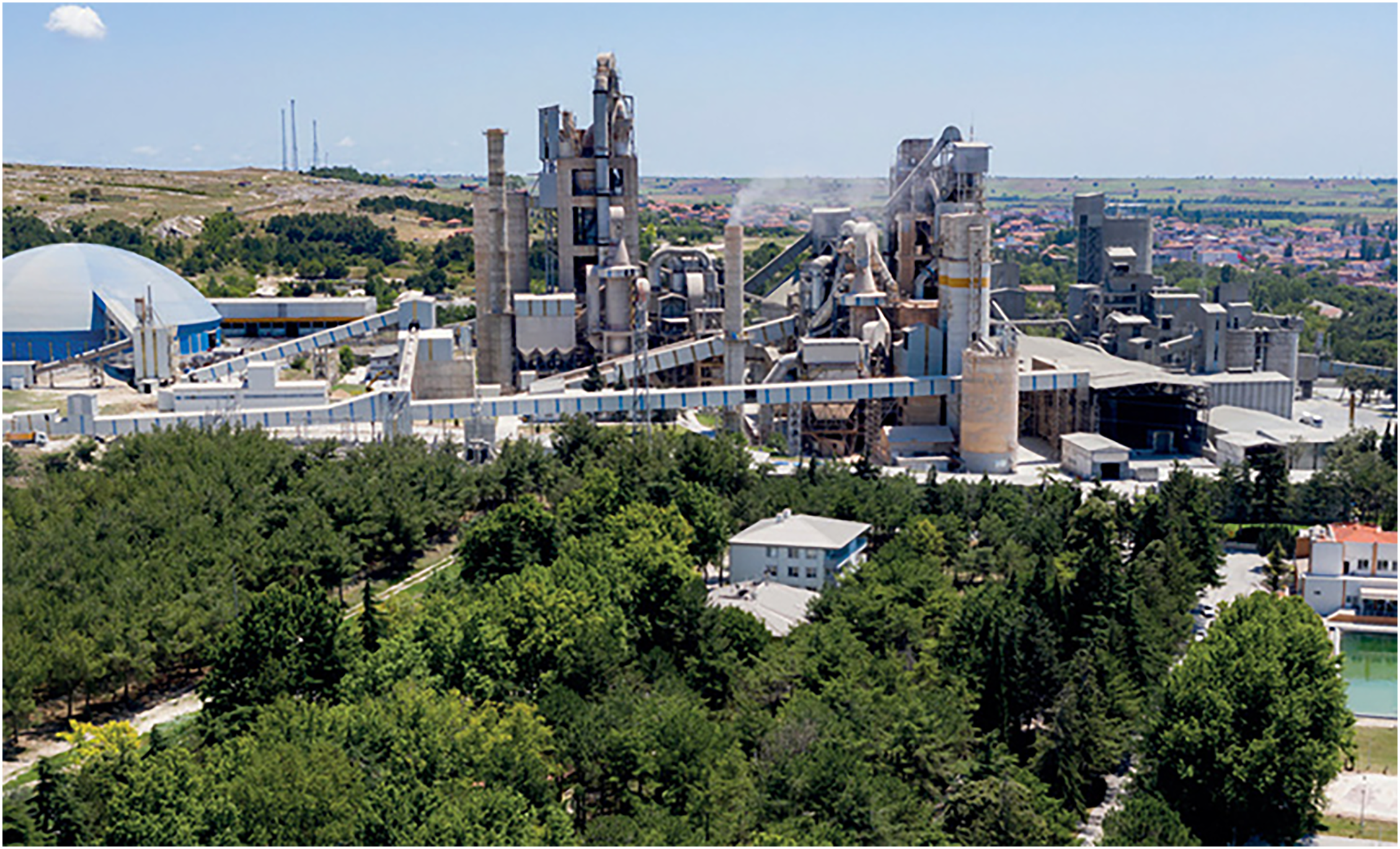
Photo: Trakya Cement plant (Credit: Limak Cement)
Limak Cement has produced and certified Türkiye’s first Limestone Calcined Clay Cement (LC3) at their 2.34 Mta capacity Limak Trakya cement factory (Photo) in Kırklareli in Western Türkiye. A certification process for the calcined clay cement has successfully been completed in January this year, under the EN-197-1 standard for Portland Composite Cement CEM II/A-M (Q-LL) 52.5 N, which allows up to 20% calcined clay in LC3-mixtures. At the moment the production of LC3 cements for reducing the clinker content in cement production and carbonisation is limited only to a few plants worldwide. Accordingly, Limak Cement is proud to have integrated this low-carbon cement into the product portfolio and produces now 5 different cement types at the Trakya plant.
In terms of capacity, Limak is the second largest cement producer in Türkiye, operating 17.7 million tons annual capacity from 11 cement plants and 37 ready-mixed concrete facilities. Beside Türkiye, the company also has a footprint in the Ivory Coast and Mozambique with own cement grinding and packing plants. In its latest investor presentation in March this year, the company outlined its commitment to a green transition, including an ambitious decarbonisation CapEx plan. This includes to increase the alternative fuel rate from almost 12% in 2024 to about 50% in 2030 and more than 95% by 2050. A second goal is to reduce significantly the clinker factor by increasing the rate of by-product materials. An example is the development of boron activated clinker (BAC), which will be used in 3 cement plants to safe 10% direct CO2 emissions. With these and other measures, the final goal by Limak Cement is to reduce the carbon emissions to almost net-zero by 2050.
https://www.linkedin.com/posts/limakcement_the-first-lc3-calcined-clay-cement-of-t%C3%BCrkiye-activity-7435640065487196160-Gl9p?utm_source=share&utm_medium=member_desktop&rcm=ACoAABfsztYBd9WE5yEd3VHJA5big54jHl0spqo
 |
Copyright © 2026 The Author. Published by Tech Science Press. This work is licensed under a Creative Commons Attribution 4.0 International License, which permits unrestricted use, distribution, and reproduction in any medium, provided the original work is properly cited. |