ARTICLE
Mechanistic study of early hydration and strength development in lithium slag cement with c-s-h-pce nanocomposites
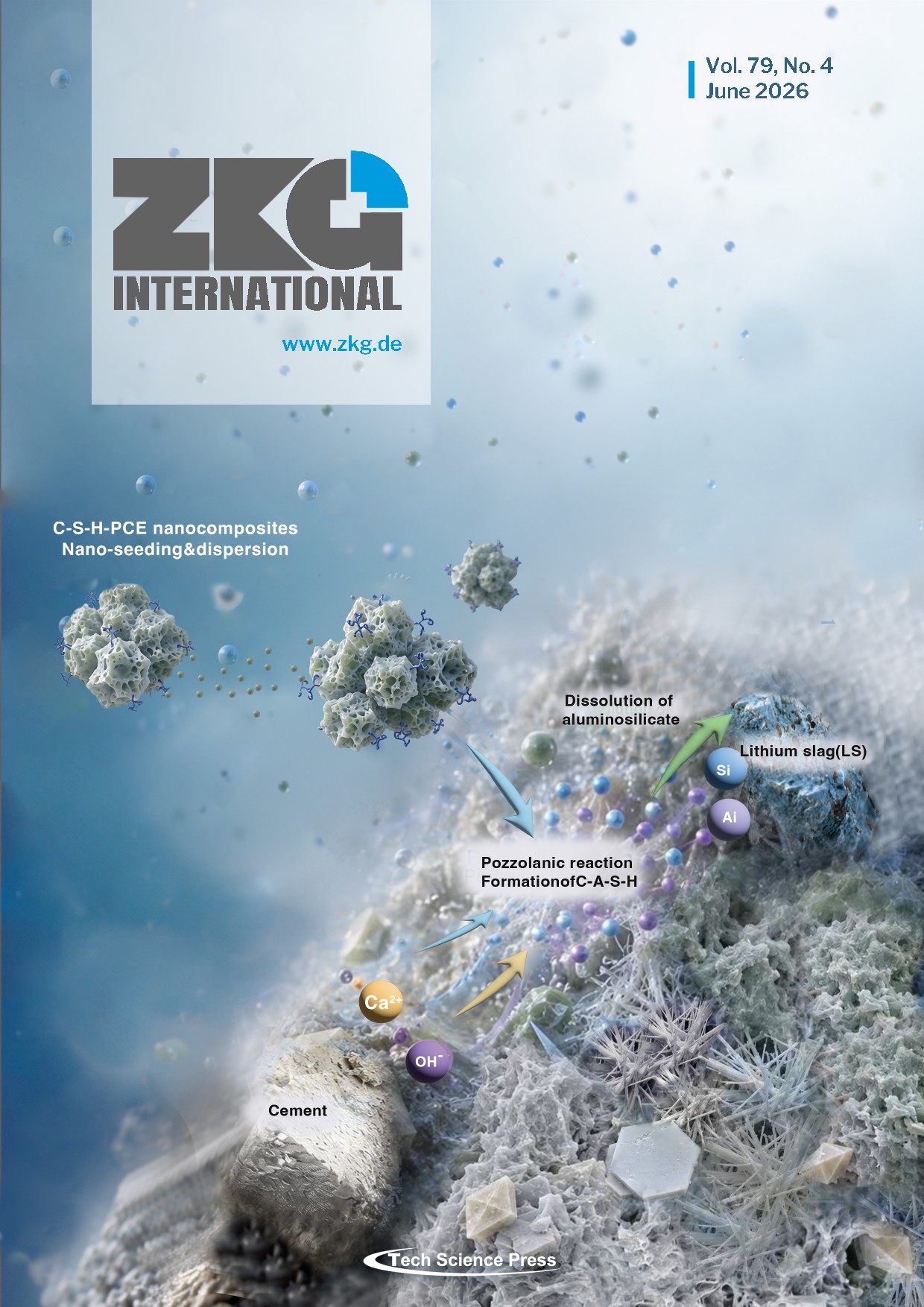
In a high-volume (50 wt.%) spodumene lithium slag (LS)-blended cement system, a polycarboxylate ether (PCE)-stabilized C-S-H nano-seeding accelerator (C-S-H-PCE) was introduced to improve the early-age mechanical properties. The effects of C-S-H-PCE on workability, early strength, and hydration behavior were systematically investigated. The results showed that C-S-H-PCE significantly improved the early compressive strength while maintaining good workability. At a dosage of 3 wt.%, the compressive strengths at 8 h, 16 h, and 24 h increased by approximately 363%, 143%, and 65%, respectively, compared with the blank sample. Isothermal calorimetry and hydration kinetics analyses demonstrated that C-S-H-PCE accelerated early hydration, increased the heat evolution rate, and reduced the nucleation energy barrier, thereby mitigating the dilution and hydration delay effects caused by high LS content. XRD and 29Si NMR analyses further confirmed that C-S-H-PCE promoted the formation of C-S-H and C-A-S-H gels. The findings reveal that C-S-H-PCE accelerates early cement hydration, leading to higher compressive strength. Meanwhile, the increased alkalinity of the pore solution promotes dissolution of the chain-like aluminosilicate framework of LS, allowing the pozzolanic reaction to occur at an earlier age. The resulting formation of C-A-S-H gel and subsequent refinement of the pore structure further contribute to the mechanical enhancement.
REFERENCES
1. Rahman SMA, Mahmood AH, Shaikh FUA, Sarker PK. Fresh state and hydration properties of high-volume lithium slag cement composites. Mater Struct. 2023;56(4):91. doi:10.1617/s11527-023-02177-x.
2. Rahman SA, Dodd A, Khair S, Shaikh FUA, Sarker PK, Hosan A. Assessment of lithium slag as a supplementary cementitious material: pozzolanic activity and microstructure development. Cem Concr Compos. 2023;143(3):105262. doi:10.1016/j.cemconcomp.2023.105262.
3. Gu T, Zhang G, Wang Z, Liu L, Zhang L, Wang W, et al. Review: the formation, characteristics, and resource utilization of lithium slag. Constr Build Mater. 2024;432(04):136648. doi:10.1016/j.conbuildmat.2024.136648.
4. He Y, Zhang G, He S, Liu S, Jiang M. Effect of C-S-H-PCE and TEA on performances of lithium slag-cement binder. J Build Eng. 2023;78(6):107659. doi:10.1016/j.jobe.2023.107659.
5. Razzazan S, Mashaan NS, Paraskeva T. Lithium slag as a supplementary cementitious material for sustainable concrete: a review. Materials. 2025;18(15):3641. doi:10.3390/ma18153641.
6. Zhou S, Zhang Z, Zhu Y. Effect of lithium slag on hydration behavior of Portland cement paste. Constr Build Mater. 2025;463(3):138909. doi:10.1016/j.conbuildmat.2024.138909.
7. Chen X, Liu T, Guo J, Nie K, Yang X, Zhang L, et al. C–S–H-PCE nanoparticles and anionic surfactants as nucleation agent in cement based materials: focus on the antagonism. Cem Concr Compos. 2024;152(3):105644. doi:10.1016/j.cemconcomp.2024.105644.
8. Yin S, Yang X, Feng X, Cao W. Structure of C–S–H/PCE prepared from PCE with different side chain densities and its effects on early hydration properties of cement. J South China Univ Technol. 2023;51(1):76–83. doi:10.12141/j.issn.1000-565X.220176.
9. Zhang L, Miao X, Kong X, Zhou S. Retardation effect of PCE superplasticizers with different architectures and their impacts on early strength of cement mortar. Cem Concr Compos. 2019;104:103369. doi:10.1016/j.cemconcomp.2019.103369.
10. Liu Q, Liu C, Wang M, Ji X, Hong F, Hou D, et al. Advancing understanding of polymer-based superplasticizers for diverse concrete applications: insights from quantum chemistry and nanoscale adsorption behavior. Cem Concr Compos. 2024;153(5):105690. doi:10.1016/j.cemconcomp.2024.105690.
11. Wang F, Kong X, Jiang L, Wang D. The acceleration mechanism of nano-C-S-H particles on OPC hydration. Constr Build Mater. 2020;249(8):118734. doi:10.1016/j.conbuildmat.2020.118734.
12. Zou F, Zhang M, Hu C, Wang F, Hu S. Novel C-A-S-H/PCE nanocomposites: design, characterization and the effect on cement hydration. Chem Eng J. 2021;412(7):128569. doi:10.1016/j.cej.2021.128569.
13. Ma Y, Sha S, Zhou B, Lei F, Liu Y, Xiao Y, et al. Adsorption and dispersion capability of polycarboxylate-based superplasticizers: a review. J Sustain Cem Based Mater. 2022;11(5):319–44. doi:10.1080/21650373.2021.1983483.
14. Zhang J, Wang Z, Liu X, Bai X, Zhou W. Microstructure and properties of C–S–H synthesized in the presence of polycarboxylate superplasticizer. Arab J Sci Eng. 2023;48(1):1041–52. doi:10.1007/s13369-022-07344-w.
15. He Y, Jiang M, Liu S, Hooton RD. Synergistic effect of C-S-H–PCE and Al2(SO4)3 on the hydration properties of lithium slag-cement composite binder. J Mater Civ Eng. 2024;36(12):04024395. doi:10.1061/jmcee7.mteng-17771.
16. Li X, Bizzozero J, Hesse C. Impact of C-S-H seeding on hydration and strength of slag blended cement. Cem Concr Res. 2022;161:106935. doi:10.1016/j.cemconres.2022.106935.
17. Kuang G, Liu Y, Li H, Xing S, Li F, Guo H. Extraction of lithium from β-spodumene using sodium sulfate solution. Hydrometallurgy. 2018;177(3):49–56. doi:10.1016/j.hydromet.2018.02.015.
18. GB/T 8076-2025. Concrete admixtures. Beijing, China: China Academy of Building Research; 2025. (In Chinese).
19. GB/T 50080-2002. Standard for test method of performance of ordinary concrete mixture. Beijing, China: China Academy of Building Research; 2002. (In Chinese).
20. Londono-Zuluaga D, Gholizadeh-Vayghan A, Winnefeld F, Avet F, Ben Haha M, Bernal SA, et al. Report of RILEM TC 267-TRM phase 3: validation of the R3 reactivity test across a wide range of materials. Mater Struct. 2022;55(5):142. doi:10.1617/s11527-022-01947-3; 30880350
21. Gao W, Zhao M, Li C, Ren Q, Gu K, Zhang Y, et al. Synergistic mechanisms of multiple components in lithium slag-based low-carbon cement: multi-scale insights from thermodynamic modeling to hydration-driven microstructural evolution. Cem Concr Compos. 2026;168:106508. doi:10.1016/j.cemconcomp.2026.106508.
22. Yang J, Zhang R, Fan L, Cui X, Wang X, Gong X. Strength and micro-mechanism analysis of concrete under corrosion-freeze-thaw-large temperature difference real exposure field. Constr Build Mater. 2025;458(3):139520. doi:10.1016/j.conbuildmat.2024.139520.
23. Robinson N, Nasharuddin R, Fridjonsson EO, Johns ML. NMR surface relaxivity in a time-dependent porous system. Phys Rev Lett. 2023;130(12):126204. doi:10.1103/physrevlett.130.126204; 37027882
24. Wang M, Hu X, Chen W, Khaskhoussi A, Guo S, Shi C. Research on the carbonation hardening properties of fully recycled concrete powder compacts. Cem Concr Compos. 2026;170:106556. doi:10.1016/j.cemconcomp.2026.106556.
25. Ruiz AI, Reyes E, Argiz C, de la Rubia MA, Moragues A. Nano-scale aluminium interaction in synthetic hydrated calcium silicate gel studied by 29Si MAS-NMR. J Span Ceram Glass Soc. 2023;62(5):388–401. doi:10.1016/j.bsecv.2022.06.004.
26. Yang SY, Yan Y, Lothenbach B, Skibsted J. Incorporation of sodium and aluminum in cementitious calcium-alumino-silicate-hydrate C-(A)-S-H phases studied by 23Na, 27Al, and 29Si MAS NMR spectroscopy. J Phys Chem C. 2021;125(51):27975–95. doi:10.1021/acs.jpcc.1c08419.
27. Kanchanason V, Plank J. C-S-H-PCE nanocomposites for enhancement of early strength of Portland cement. In: Proceedings of the 14th International Congress on the Chemistry of Cement; 2015 Oct 13–16; Beijing, China. p. 13–6.
28. Zhan P, Wang J, Zhao H, Li W, Shah SP, Xu J. Impact of synthetic C-S-H seeds on early hydration and pore structure evolution of cement pastes: a study by 1H low-field NMR and path analysis. Cem Concr Res. 2024;175:107376. doi:10.1016/j.cemconres.2023.107376.
29. Kanchanason V, Plank J. Role of pH on the structure, composition and morphology of C-S-H–PCE nanocomposites and their effect on early strength development of Portland cement. Cem Concr Res. 2017;102(8):90–8. doi:10.1016/j.cemconres.2017.09.002.
30. Thomas JJ, Jennings HM, Chen JJ. Influence of nucleation seeding on the hydration mechanisms of tricalcium silicate and cement. J Phys Chem C. 2009;113(11):4327–34. doi:10.1021/jp809811w.
31. Hou D, Ji X, Wang P, Zhang J, Wang M. Atypical adsorption of polycarboxylate superplasticizers on calcium silicate hydrate surface: converting interaction by solvent effects. Constr Build Mater. 2022;330(10):127160. doi:10.1016/j.conbuildmat.2022.127160.
32. Kanchanason V, Plank J. Effectiveness of a calcium silicate hydrate–Polycarboxylate ether (C-S-H–PCE) nanocomposite on early strength development of fly ash cement. Constr Build Mater. 2018;169(8):20–7. doi:10.1016/j.conbuildmat.2018.01.053.
33. Plank J, Echt T. C-S-H-PCE nanofoils: a new generation of accelerators for oil well cement. In: Proceedings of the SPE International Conference on Oilfield Chemistry; 2019 Apr 8–9; Galveston, TX, USA. doi:10.2118/193639-ms.
34. Fang Y, Zhang L, Li L, Zhao M, Wang Q, Mei Y. Preparation of nano-sized C-S-H and its acceleration mechanism on Portland cement hydration at different temperatures. Materials. 2023;16(9):3484. doi:10.3390/ma16093484; 37176366
35. Cuesta A, Morales-Cantero A, de la Torre AG, Aranda MAG. Recent advances in C-S-H nucleation seeding for improving cement performances. Materials. 2023;16(4):1462. doi:10.3390/ma16041462; 36837090
36. Juenger MCG, Snellings R, Bernal SA. Supplementary cementitious materials: new sources, characterization, and performance insights. Cem Concr Res. 2019;122:257–73. doi:10.1016/j.cemconres.2019.05.008.
37. Li Y, Liu X, Zhu Y, Jiang M, Lu L, Li X, et al. Advancement of early strength of supplementary cementitious materials: a review. J Build Eng. 2026;119:115172. doi:10.1016/j.jobe.2025.115172.
38. Ramezani M, Kim YH, Sun Z. Mechanical properties of carbon-nanotube-reinforced cementitious materials: database and statistical analysis. Mag Concr Res. 2020;72(20):1047–71. doi:10.1680/jmacr.19.00093.
39. Liu J, An S, Zhang Y. Mechanism of regulating the mechanical properties and paste structure of supersulfated cement through ultrafine iron tailings powder. Cem Concr Compos. 2023;140(5):105061. doi:10.1016/j.cemconcomp.2023.105061.
40. Jennings HM. A model for the microstructure of calcium silicate hydrate in cement paste. Cem Concr Res. 2000;30(1):101–16. doi:10.1016/S0008-8846(99)00209-4.
41. Owens K, Russell MI, Donnelly G, Kirk A, Basheer PAM. Use of nanocrystal seeding chemical admixture in improving Portland cement strength development: application for precast concrete industry. Adv Appl Ceram. 2014;113(8):478–84. doi:10.1179/1743676114Y.0000000176; 40784350
42. Thomas JJ, Biernacki JJ, Bullard JW, Bishnoi S, Dolado JS, Scherer GW, et al. Modeling and simulation of cement hydration kinetics and microstructure development. Cem Concr Res. 2011;41(12):1257–78. doi:10.1016/j.cemconres.2010.10.004.
43. Nicoleau L. Accelerated growth of calcium silicate hydrates: experiments and simulations. Cem Concr Res. 2011;41(12):1339–48. doi:10.1016/j.cemconres.2011.04.012.
44. Han F, Zhang Z, Wang D, Yan P. Hydration heat evolution and kinetics of blended cement containing steel slag at different temperatures. Thermochim Acta. 2015;605:43–51. doi:10.1016/j.tca.2015.02.018.
45. Han F, Zhang Z, Wang D, Yan P. Hydration kinetics of composite binder containing slag at different temperatures. J Therm Anal Calorim. 2015;121(2):815–27. doi:10.1007/s10973-015-4631-z; 30311153
46. Zhang N, Li HX, Liu XM. Hydration kinetics of cementitious materials composed of red mud and coal gangue. Int J Miner Metall Mater. 2016;23(10):1215–24. doi:10.1007/s12613-016-1341-x; 30311153
47. Chen Z, Luo J, Wei J, Liu J, Tang J. Quantitative analysis of hydration kinetics and compressive strength model of cement-based materials blended with Sugarcane Bagasse Ash. Constr Build Mater. 2025;489(6):142334. doi:10.1016/j.conbuildmat.2025.142334.
48. Shao Z, Cao M, Zheng X. Limestone particle sizes and sulfate impact on the early hydration of limestone calcined clay cement. J Build Eng. 2024;97:110848. doi:10.1016/j.jobe.2024.110848.
49. Chen J, Jia J, Qi Z, Dong S, Mou Y, Zhu M. Impact of synthetic C-S-H-GO seeds on hydration kinetics and pore structure evolution of cement pastes. Cem Concr Compos. 2026;168:106470. doi:10.1016/j.cemconcomp.2026.106470.
50. Sun Y, Wang ZH, Park DJ, Chen YK, Kim HS, Kim WS, et al. Mathematical determination of the maximum heat release for fly ash cement paste: effect of heat flow monitoring time, calculation approach and fly ash content. Thermochim Acta. 2023;726:179553. doi:10.1016/j.tca.2023.179553.
51. Kalina RD, Al-Shmaisani S, Ferron RD, Juenger MCG. False positives in ASTM C618 specifications for natural pozzolans. ACI Mater J. 2019;116(1):165–72. doi:10.14359/51712243.
52. Vallina D, Santacruz I, Morales-Cantero A, Rodríguez-Ruiz MD, Cuesta A, De la Torre AG, et al. Low-grade kaolinitic clays as SCMs for low-carbon cements and strength improvement by C-S-H gel nucleation seeding. Cem Concr Res. 2026;199:108036. doi:10.1016/j.cemconres.2025.108036.
53. Andrade Neto JS, Raja R, da Rosa P, Kirchheim AP. Hydration of cubic C3A in the presence of polycarboxylate-based superplasticizers. In: Proceedings of the Simpósio Brasileiro de Ciência Do Cimento (SBCC); 2025 Jun 27–Jul 2; São Paulo, Brazil.
54. Yang Y, Zhang Q, Shu X, Wang X, Ran Q. Influence of sulfates on formation of ettringite during early C3A hydration. Materials. 2022;15(19):6934. doi:10.3390/ma15196934; 36234274
55. Crasselt C, Schmidt W, Sturm H. Influence of rheology modifying admixtures on hydration of cementitious suspensions. In: Proceedings of the 15th International Congress on the Chemistry of Cement; 2019 Sep 16–20; Prague, Czech Republic. p. 1–8.
56. Scrivener K, Snellings R, Lothenbach B. A practical guide to microstructural analysis of cementitious materials. Boca Raton, FL, USA: CRC Press; 2016.
57. Skibsted J, Snellings R. Reactivity of supplementary cementitious materials (SCMs) in cement blends. Cem Concr Res. 2019;124:105799. doi:10.1016/j.cemconres.2019.105799.
58. Lothenbach B, Scrivener K, Hooton RD. Supplementary cementitious materials. Cem Concr Res. 2011;41(12):1244–56. doi:10.1016/j.cemconres.2010.12.001.
59. Myers RJ, Bernal SA, Provis JL. A thermodynamic model for C-(N-) A-S-H gel: CNASH_ss. derivation and validation. Cem Concr Res. 2014;66:27–47. doi:10.1016/j.cemconres.2014.07.005.
60. Wang H, Feng P, Liu X, Shi J, Wang C, Wang W, et al. The role of ettringite seeds in enhancing the ultra-early age strength of Portland cement containing aluminum sulfate accelerator. Compos Part B Eng. 2024;287(16):111856. doi:10.1016/j.compositesb.2024.111856.
61. Richardson IG. The calcium silicate hydrates. Cem Concr Res. 2008;38(2):137–58. doi:10.1016/j.cemconres.2007.11.005.
62. Cong X, Kirkpatrick RJ. 29Si MAS NMR study of the structure of calcium silicate hydrate. Adv Cem Based Mater. 1996;3(3–4):144–56. doi:10.1016/S1065-7355(96)90046-2.
63. Sun GK, Young JF, Kirkpatrick RJ. The role of Al in C–S–H: nMR, XRD, and compositional results for precipitated samples. Cem Concr Res. 2006;36(1):18–29. doi:10.1016/j.cemconres.2005.03.002.
64. Hay R, Li J, Celik K. Influencing factors on micromechanical properties of calcium (alumino) silicate hydrate C-(A-) S-H under nanoindentation experiment. Cem Concr Res. 2020;134:106088. doi:10.1016/j.cemconres.2020.106088.
65. Zheng Q, Jiang J, Yu J, Li X, Li S. Aluminum-induced interfacial strengthening in calcium silicate hydrates: structure, bonding, and mechanical properties. ACS Sustain Chem Eng. 2020;8(7):2622–31. doi:10.1021/acssuschemeng.9b04862.
66. Juilland P, Gallucci E, Flatt R, Scrivener K. Dissolution theory applied to the induction period in alite hydration. Cem Concr Res. 2010;40(6):831–44. doi:10.1016/j.cemconres.2010.01.012.
67. Land G, Stephan D. The influence of nano-silica on the hydration of ordinary Portland cement. J Mater Sci. 2012;47(2):1011–7. doi:10.1007/s10853-011-5881-1; 30311153
68. Jin H, San Nicolas R, Yu X, Wang T, Ngo T. Development, properties, and resource utilization of delithiated β spodumene as new-type building materials: recent progress and future challenges. Cem Concr Compos. 2026;169(2):106549. doi:10.1016/j.cemconcomp.2026.106549.
69. Wang R, Li Y, Zhu G, Cao Y. Effects of dissolution by alkali treatment on anisotropic surface properties and flotation behavior of spodumene. Colloids Surf A Physicochem Eng Asp. 2023;675:132088. doi:10.1016/j.colsurfa.2023.132088.
70. Ye J, Chen J, Luo K, Yan F, Zhang W, Ren X, et al. The leaching model and leaching kinetics of lithium slag in alkaline solution. Constr Build Mater. 2024;432(Pt 2):136642. doi:10.1016/j.conbuildmat.2024.136642.
71. Wang N, Zhao J, Zhang H, Wang T, Shen J, Kang Q, et al. Enhancing Li+ exchange efficiency of lithium slag via alkaline adjustment: investigation into the multi-cation systems and insights for waste recycling. J Environ Chem Eng. 2026;14(2):121194. doi:10.1016/j.jece.2026.121194.
72. Nie S, Skibsted J. Aluminum distribution in C-(A)-S-H and calcium aluminate hydrate phases of Portland cement–metakaolin–limestone blends studied by 27Al and 29Si NMR spectroscopy. Cem Concr Res. 2024;186:107664. doi:10.1016/j.cemconres.2024.107664.
Cite This Article
APA Style
Xie, H., Lei, L., Chan, H. K., Plank, J. (2026). Mechanistic study of early hydration and strength development in lithium slag cement with c-s-h-pce nanocomposites. ZKG International, 79(4), 28–47. https://doi.org/10.32604/zkg.2026.085547
Vancouver Style
Xie H, Lei L, Chan HK, Plank J. Mechanistic study of early hydration and strength development in lithium slag cement with c-s-h-pce nanocomposites. ZKG Int.. 2026;79(4):28–47. https://doi.org/10.32604/zkg.2026.085547
IEEE Style
H. Xie, L. Lei, H. K. Chan, and J. Plank, “Mechanistic study of early hydration and strength development in lithium slag cement with c-s-h-pce nanocomposites,” ZKG Int., vol. 79, no. 4, pp. 28–47, 2026. https://doi.org/10.32604/zkg.2026.085547