Gypsum board empowering quality housing: innovative green material strategies for urban renewal
According to data from Global Gypsum, as of the first half of 2023, there were 435 gypsum-board factories operating in 72 countries. China and the United States are the two largest producers, accounting for roughly 22% and 25% of global capacity, respectively. From an enterprise perspective, the top three industry giants—Knauf (Germany), BNBM (China), and Saint-Gobain (France)—collectively hold a 61% share of the global production capacity.
OneStone Consulting forecasts a compound annual growth rate (CAGR) of 5.3% for the global gypsum-board market between 2025 and 2030, corresponding to a market size of USD 281 billion. The two most promising regions are China and the emerging markets of Africa, Central Asia, Southeast Asia, and South America. By 2030, China’s gypsum-board market is expected to reach USD 61.3 billion, surpassing the United States and Europe to become the world’s largest consumption hub. Conversely, regions like Africa, Central Asia, Southeast Asia, and South America currently exhibit low penetration rates for gypsum board. However, rising urbanisation and the strategic entry of major manufacturers are expected to drive robust growth. The market in these emerging regions is anticipated to achieve a market size of USD 90.5 billion by 2030, making it the second-largest growth region globally.
2 Gypsum board as the preferred material forurban renewal
Gypsum board can be employed in interior walls, ceilings, decorative panels, and lightweight steel-stud systems. It integrates four key functionalities—fire resistance, sound insulation, thermal insulation, and humidity regulation—making it a critical material for realizing the four core systems of “quality housing.” In addition to its essential contribution to thermal performance and energy efficiency, gypsum-based construction offers significant safety and comfort benefits. Moreover, in renovation projects, internal insulation is usually the best way to improve a building’s energy performance.
A European market report highlights that fibre-reinforced gypsum boards have become the material of choice for urban renovation and energy-saving retrofits. The European Gypsum Industry Solutions white paper documents historic-building renovation cases in which a composite panel—comprising a gypsum core and a grey polystyrene insulation layer—achieves a thermal conductivity of λ = 0.032 W/(m·K) through thermal optimisation, resulting in a 53% reduction in primary energy consumption [1].
Beijing New Building Materials (BNBM) has developed a dedicated exterior-wall insulation and renovation system for urban renewal projects, focusing on energy-efficient retrofits of existing buildings (Figure 1) [2]. The core technical approach adopts a dry-construction method: a light-gauge steel framework is directly installed on the original building façade (concrete, brick, or block walls) without the need for extensive demolition or surface preparation. Subsequently, the cavities within the steel framework are either filled with rock wool insulation or fitted with prefabricated Jinbang boards—these boards serve dual functions as external cladding and a continuous thermal insulation barrier, forming an integrated protective and decorative layer.
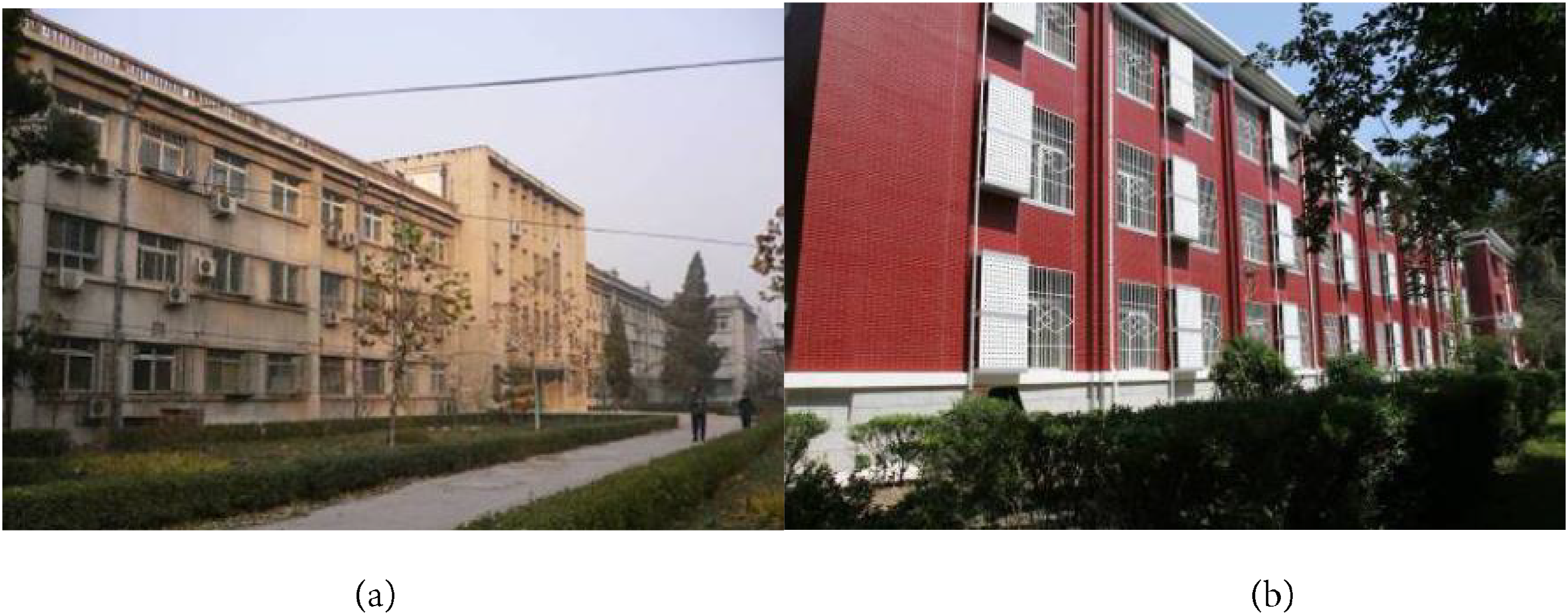
Fig. 1 Comparative views of the building: (a) pre-renovation and (b) post-renovation
In terms of pre- and post-renovation comparisons, the system achieves comprehensive performance upgrades: Before renovation (Figure 1a), the original exterior walls typically suffered from issues such as uneven surfaces, poor moisture resistance, insufficient fire safety, and low thermal insulation efficiency. After renovation (Figure 1b), the system significantly enhances wall flatness and effectively prevents moisture intrusion; the fire rating is improved, and thermal insulation performance is boosted (reflected in reduced U-value). Aesthetically, the diverse color, texture, and finish options of Jinbang boards realize a modern transformation of the building’s appearance, addressing the outdated visual issue of old façades. Economically and energy-efficiently, post-retrofit data confirms that the system reduces combined energy consumption and renovation/operational costs by approximately 30% compared to the pre-retrofit state.
To achieve a holistic renovation effect, BNBM also provides supporting interior wall solutions: gypsum boards are fixed to interior surfaces via adhesive or secondary framing, creating smooth and level walls ready for decoration while further enhancing thermal insulation and acoustic performance. This integrated exterior-interior system is widely applicable to industrial, commercial, and residential buildings in urban renewal projects, offering an efficient, cost-effective, and comprehensive renovation solution.
The Hong Kong Construction Industry Council (HKICM), Energy Institute, Hong Kong Institution of Engineers (Environmental Division), Building Services Operation and Maintenance Executives Society, and Asian Institute of Intelligent Building have been exploring methodologies for achieving energy-efficient construction and maintenance throughout a building’s lifecycle. Their research highlights the fire-resistance, acoustic, and low-carbon advantages of gypsum-block walls in public-space upgrades within old-city renewal projects [3].
3 Future development trends for gypsum board
Functional Integration—Multi-performance boards incorporating fire resistance, acoustic insulation, thermal insulation, humidity regulation, and antimicrobial properties will become standard, satisfying the demands of prefabricated and smart residential construction. Examples like BNBM’s light-gauge steel framing systems and “formaldehyde-purifying” boards, Yoshino’s acoustically enhanced panels, and Eco Buildings Group’s Glass Fibre-Reinforced Gypsum (GFRG) modular systems exemplify the integrated response to the “Quality Housing” requirements for safety, comfort, sustainability, and intelligence.
Green-Low-Carbon Transformation—Manufacturers are deepening sustainability across the entire value chain by exploiting industrial by-product gypsum, recovering waste heat, adopting low-temperature drying, and powering processes with renewable energy. Notable initiatives include Saint-Gobain’s zero-carbon factory, Knauf’s 35% recycled gypsum usage, Etex’s 100% recycled-gypsum boards, Georgia-Pacific’s low-energy drying facilities, and Trevo Drywall’s LNG (liquefied natural gas)-fueled calcination and drying system. These efforts collectively drive substantial carbon-emission reductions and close the material loop.
Recycling and Circular Economy—Gypsum recycling is emerging as a cornerstone of national raw-material supply. Commercial-scale applications of Saint-Gobain’s CarbonLow, Knauf France’s 35% recycled gypsum, and Etex’s 100% recycled boards are already established in North America and Europe [4]. Saint-Gobain Spain has launched the REcircula platform to manage and valorise up to 70% of construction waste generated by its clients [5], underscoring the accelerating transition toward a green, circular gypsum industry.
Intelligent Standardisation—The deep integration of Artificial Intelligence (AI), the Industrial Internet of Things (IIoT), and automated equipment into production facilities will enable real-time process monitoring, full quality traceability, and flexible production scheduling. The rapid adoption of prefabricated and modular construction is prompting gypsum board manufacturers to transition toward factory-produced components. Formatt Building Products Spain, for instance, is constructing a new gypsum-wallboard plant in La Rioja that incorporates cutting-edge process automation, environmental engineering, and digital control to minimise CO2 emissions while maximising edge quality and panel uniformity.
Globalisation and Harmonised Standards— Internationalization will promote the implementation of unified material standards globally, facilitating rapid compliance and supply-chain coordination across regions. The global footprints of major players—BNBM’s presence in over 90 countries, Knauf’s factories in over 100 countries, Saint-Gobain’s simultaneous capacity expansions in North America, Europe, and Asia, and Etex’s continued investments across Latin America, Europe, and Asia—demonstrate a clear trend of production capacity shifting towards emerging markets (Latin America, Southeast Asia, Africa). This movement actively promotes the establishment of globally consistent green building material standards.
Gypsum board is on the verge of taking on an increasingly pivotal and sustainable position within the future building-material ecosystem. The convergence of the outlined trends—functional integration, green-low-carbon transformation, recycling and circular economy, intelligent standardization, and the globalization of harmonized standards—will significantly amplify its contribution to urban renewal, smart housing, prefabricated construction, and the broader green-building landscape.
To translate this potential into tangible impact, focused action is required from industry, policymakers, and researchers. For industry stakeholders, the priority should be accelerating the R&D and commercialization of next-generation products, such as multi-functional composites and customized solutions for specific climates and building types. For policymakers, strategic measures include formally listing high-performance gypsum systems in green-building material catalogs and urban renewal guidelines, developing supportive standards, and implementing incentives such as tax benefits for certified products and mandatory recycling protocols for construction waste. For the research community, future work should prioritize quantitative life-cycle carbon assessments of advanced gypsum systems, the development of bio-based or smart composites, and the exploration of viable socio-economic models for scaling recycling infrastructure, particularly in emerging markets.
Ultimately, the synergistic advancement of technology, policy, and collaborative research is essential to fully harness its potential of gypsum board, solidifying its role as a foundational material for constructing resilient, sustainable, and high-quality urban environments.
[1] EuroGypsum. Increasing energy efficiency in buildings with internal insulation: the European gypsum industry solutions. Brussels, Belgium: EuroGypsum; 2020.
[2] Products and solutions [Internet]. [cited 2026 Jan 1]. Available from: https://www.bnbm.com.cn/category/reform.html.
[3] Building green with gypsum block walls: unlocking the potential of self standing 9 m high walls without stiffeners and exploring ways to achieve energy efficient construction and maintenance throughout its life cycle [Internet]. [cited 2026 Jan 1]. Available from: https://hkicm.org.hk/event/building-green-with-gypsum-block-walls-unlocking-the-potential-of-self-standing-9m-high-walls-without-stiffeners-and-exploring-ways-to-achieve-energy-efficient-construction-and-maintenance-throughout/.
[4] Minsheng Securities. Gypsum board going global: Africa & central Asia as the next high growth markets. Beijing, China Minsheng Securities; 2024.
[5] Saint Gobain Spain launches gypsum wallboard recycling service [Internet]. [cited 2026 Jan 1]. Available from: https://www.globalgypsum.com/news/2452%20saint%20gobain%20spain%20launches%20gypsum%20wallboard%20recycling%20service.