Brazil at the forefront of future construction
How concrete 3D printing is redefining processes, timelines and design freedom in the construction industry
1 When construction meets additive manufacturing
For decades, the construction sector has evolved primarily through incremental improvements: new materials, more precise software tools, and more efficient project management. Yet the core construction process itself has remained largely unchanged. In recent years, however, one technology has begun to disrupt this paradigm: concrete 3D printing.
It is within this context that Cosmos 3D, a Spanish-Brazilian company, has emerged, combining the industrial and construction expertise of the Katz Group with the additive manufacturing technology developed by the Spanish company IT3D. The result is not a disruptive promise in the marketing sense, but a technically viable and industrially grounded pathway for the sector.
“Concrete 3D printing is not intended to replace all existing construction methods. It is designed to address specific limitations of conventional construction, particularly those related to time, precision and process control,” explains Daniel Katz, Co-CEO and co-founder of Cosmos 3D.
Internationally, concrete 3D printing began to gain momentum in the 2010s, initially as an experimental technology. As the systems matured, the focus shifted from pure printing speed to structural performance, material control and compliance with technical standards.
In Brazil, adoption is more recent but steadily advancing, driven by applied research and by companies willing to translate innovation into industrial execution.
2 The technology behind 3D printing
Concrete 3D printing is based on the controlled deposition of cement-based material, layer by layer, following a digital model. In this approach, digital design becomes not only a representation of the project, but the direct execution logic of the structure.
This level of control brings construction closer to an industrial manufacturing process. Tool paths, extrusion speed and layer height are predefined, significantly reducing the variability typically associated with conventional building sites.
“What is often underestimated is that this technology requires more engineering, not less. Planning and material design must be far more precise from the very beginning,” notes Katz.
The system is composed of three main components: an integrated mixing and pumping unit, an extrusion nozzle and a gantry-based robotic printer. The mixing system must be efficient to ensure consistent material quality, while the pump and extrusion nozzle must operate steadily to maintain a constant material flow.
The material itself is not conventional concrete. At Cosmos 3D, a proprietary formulation was developed, where more than 300 formulation trials were conducted to develop a mixture that ensures pumpability, interlayer stability, structural performance and lower cement consumption. Mechanical testing carried out in cooperation with Brazilian universities, following Brazilian standards (ABNT NBR 16868), demonstrated consistent structural behavior. Printed panels reached compressive strengths above 20 MPa, with adequate performance in both compression and flexure, confirming the technical feasibility of the method.
Another key feature is operational flexibility. Printing can be performed directly on the construction site (onsite) or in a controlled factory environment (offsite), followed by transportation and final assembly. This dual approach expands the range of applications, enabling adaptation to different project scales and logistical conditions.
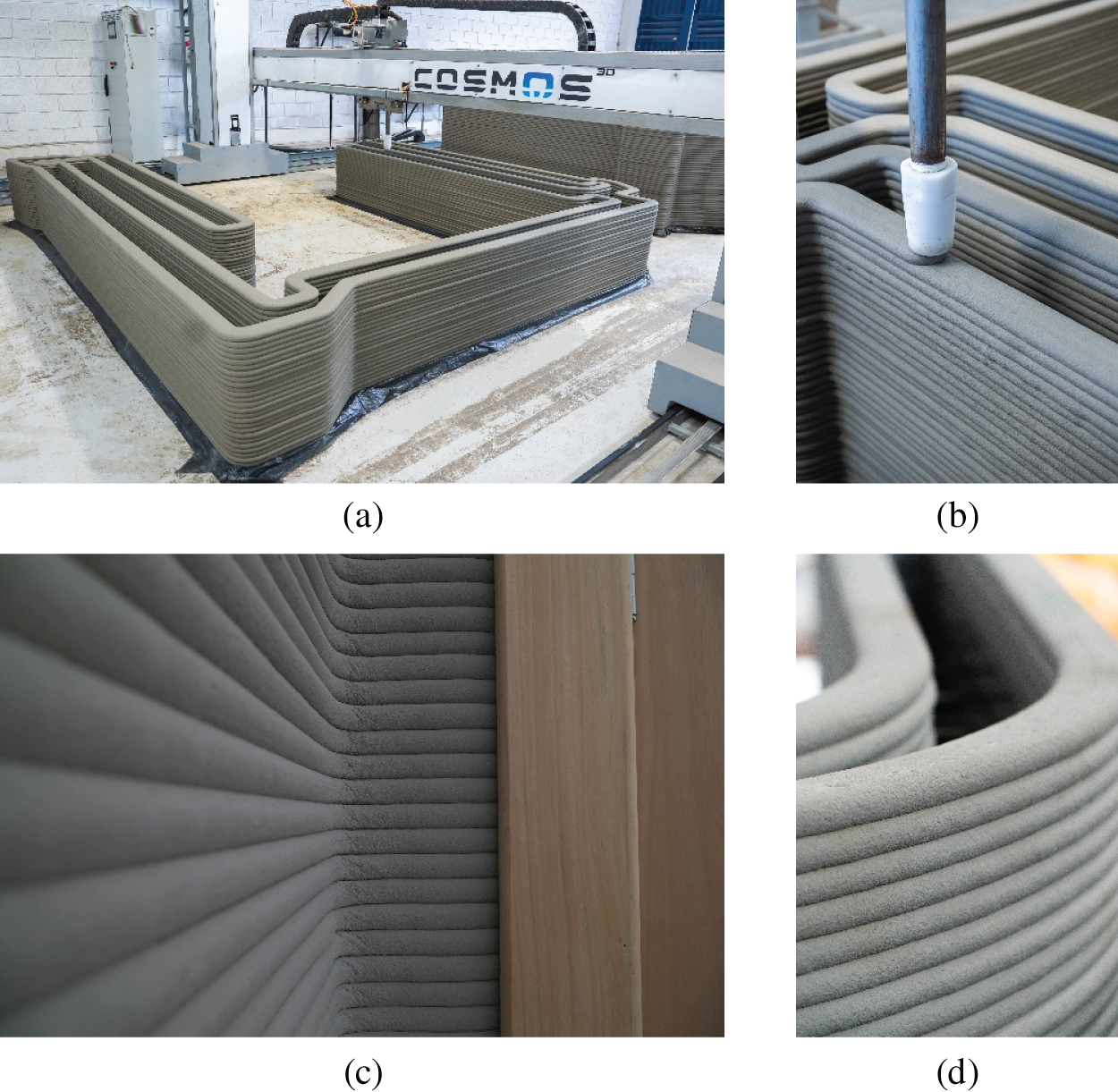
Figure 1 Process of 3D concrete printing; (a) Large-scale 3D concrete printing of structural walls; (b) Extrusion nozzle depositing concrete layers; (c) Interface between printed concrete wall and conventional element; (d) The technology allows the printing of complex and curved geometries (Credit: Lucas Melo)
3 Process evolution, productivity gains and the future of construction
The maturity of concrete 3D printing can be assessed not only by completed projects, but also by the measurable performance improvements achieved over time. Between 2024 and 2025, Cosmos 3D recorded substantial gains in productivity and process efficiency. Printing speed increased significantly, with an improvement of approximately 400%, resulting from fine-tuning of the material, extrusion system and machine parameters. This improvement raised daily production capacity from roughly 2.5 tons to over 10 tons of printed material per day, an increase exceeding 400%.
At the same time, material consumption was reduced by approximately 25%, driven by optimization of layer width and height. This directly improves the sustainability profile of the process by reducing waste and increasing overall material efficiency. “These results are not the outcome of a single technological breakthrough, but of continuous, incremental development. Each project, each test and each printed structure contributes to refining the system,” says Katz.
In practical terms, these gains translate into shorter construction cycles, higher predictability and new architectural possibilities. The technology has already been applied to residential units, showrooms, commercial structures and urban furniture, serving as a real-world development platform.
Internationally, countries such as Germany, the Netherlands, the United States and China are moving rapidly in regulation and industrial scaling. The discussion is no longer about whether concrete 3D printing is viable, but how it can be integrated into existing construction ecosystems. In Brazil, the next step lies in technical training and knowledge dissemination. Rather than replacing conventional construction, concrete 3D printing is becoming a strategic tool to expand capabilities and address long-standing industry challenges.
“Technology only makes sense when it is applied with technical responsibility and a long-term vision,” concludes Katz. “Our objective is to support the evolution of the construction sector through data-driven engineering, advanced technology, and industrial reliability.”
4 Real-world application cases
Casa LR, the first high-end residential project in the Ville de Lacs gated community, was executed using Cosmos 3D’s concrete printing technology. The project comprises a total built area of 420 m2, including 330 m2 of main living spaces and 70 m2 of complementary areas. The wall system was produced and installed by Cosmos 3D in approximately 15 days, using an industrialized construction process that ensures high execution speed, dimensional accuracy and a consistent surface finish.
The project represents a milestone in the adoption of advanced construction technologies within the development, combining efficiency, digital manufacturing and architectural quality—key attributes for high-end residential real estate.
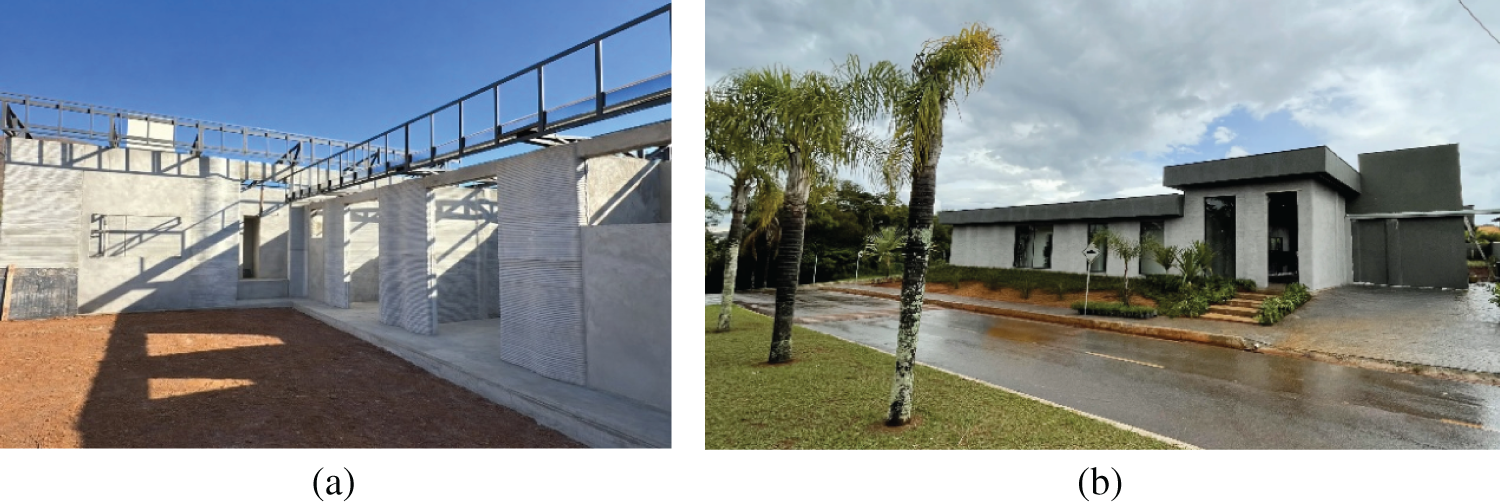
Figure 2 High-end house printed using 3D concrete technology in Brazil; (a) Unfinished structure with newly assembled 3D concrete walls; (b) The house has a total area of 193 m² and is the first high-end residence in Brazil constructed using 3D-printed walls (Credit: Cosmos 3D)
4.2 Vale do Sol commercial development
Cosmos 3D delivered the structural components of a commercial development located in a prime area of Vale do Sol, close to several high-end residential communities. The project was designed to meet the growing demand for qualified services in a rapidly expanding urban area.
With a total site area of approximately 400 m² and 120 m² of built space, the development includes an already operational real estate office and two additional retail units currently being offered for lease, providing flexibility for different commercial activities. The spatial layout was designed to promote integration between the units and to enhance the functionality of the commercial center.
In addition to its commercial use, the project includes provisions for electric vehicle charging infrastructure, aligning the development with emerging trends in mobility and sustainability. The project demonstrates the versatility of Cosmos 3D’s construction solutions when applied to commercial buildings and urban infrastructure in high-value real estate areas.
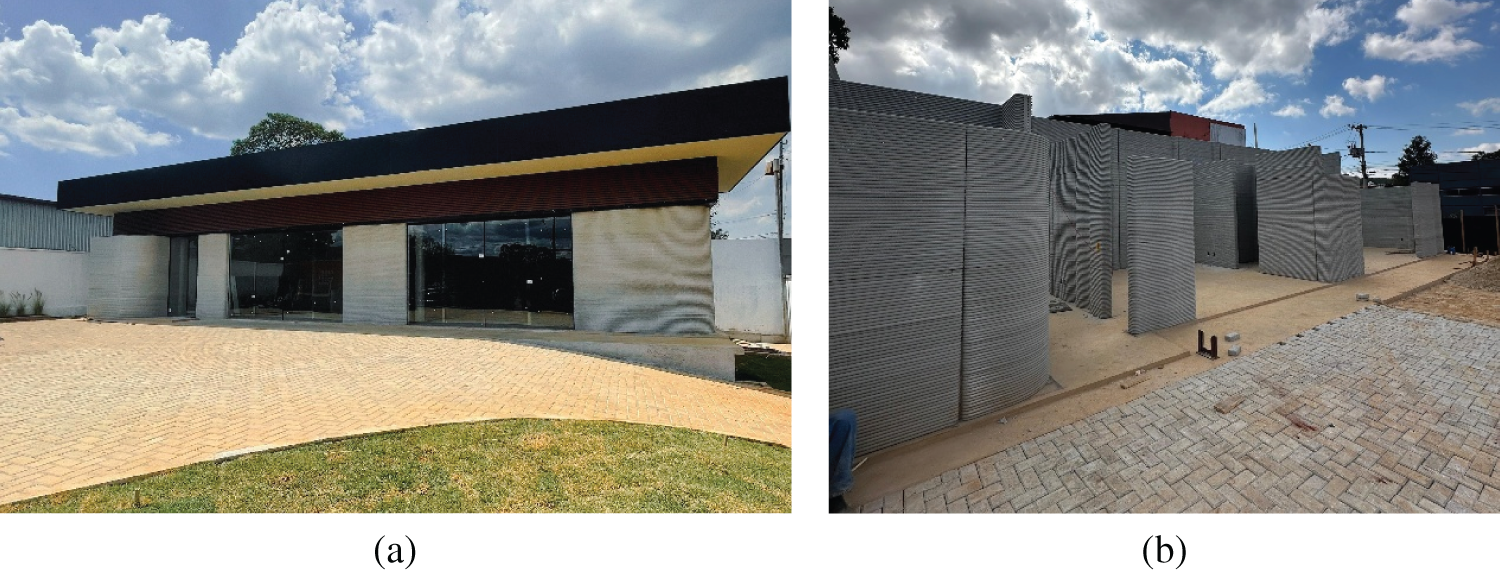
Figure 3 Commercial development built with 3D concrete construction technology by Cosmos 3D, located in Vale do Sol, Brazil. (a) Completed building with finished façade and architectural finishes; (b) Construction phase highlighting the assembly of 3D-printed concrete wall systems (Credit: Cosmos 3D)